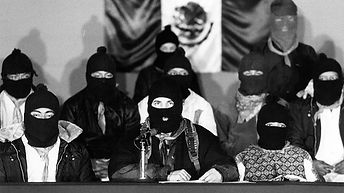
When the Revolution Eats Its Own Pyramid
There is a sentence that repeats like a dogma in every revolutionary tradition: unity of command is a precondition for victory. The army needs a head. The organization needs leadership. The revolution needs a vanguard. That is what we were taught. That is what we believed. And then the Zapatistas arrived and cut the pyramid in half.
And they did so from a starting point we often lose when we read them as an “organizational model”: from the very beginning, Zapatismo was an explicit rupture with the imperium—with the West not as “geography,” but as a colonial construction: a historical system of conquest, hierarchy, and imposition that learned to present itself as neutral, natural, universal.
And they did it not metaphorically. Literally.
In late December 2025, at the Semillero (1) of Cideci, Captain Marcos described a process that began in 2012. When command passed to Subcomandante Moisés, the first order was: find your successor. The classic logic. The pyramid reproduces itself. But Moisés did not look for one successor—he looked for many. And then more. And then even more. Until the “inter-zonal meetings” became, in Marcos’s words, a “nightmare”—because now more people participate than can fit in a room.
“They participate in ever greater numbers, until the moment comes when they are equals.”
Let’s stop here. Let that sentence sink in.
Raúl Zibechi, commenting on this development, calls it “something entirely new in the world of anti-capitalist struggle.” And he’s right—but not in the way we usually think.
It is not new because no one had ever thought it before. The critique of hierarchy is as old as hierarchy itself. From Bakunin to Rosa Luxemburg, from the anarchists of Spain to workers’ councils, the idea was there. What is new is that someone is doing it—and doing it under conditions of war, encirclement, the presence of an enemy. Precisely where “common sense” says: now is not the time for experiments.
And here we need a pause—about the parallels we draw, and the “models” we export as if they were instruction manuals. Let’s go to Rojava, which is once again topical because of developments in Syria. The Rojava experiment was elevated (mostly outside its own terrain) into a packaged proposition: an organizational “model” that fits into a feature, a panel, a nice text that ends with “let’s do it too.” As if it were a matter of proper institutional arrangement. As if it were architecture, not war.
And somewhere along the way we forget something basic—almost comically tragic. That this “turn” did not appear as a popular revelation in a square, but as a political recomposition centered on an imprisoned leader. Öcalan, from his cell, corresponds with an American theorist (Bookchin) and moves from a hard Maoist national-liberation line to “democratic confederalism.” That alone should temper our appetite for idealizations: searching for an exit from historical defeat through a Western library while the world burns around you is not “pure theory.” It is a symptom. And it is also history’s irony.
Because in the Middle East—and especially in the Arab world—the imperium is not an abstract concept. It is the way history has been written. It is the blood that made “the ground” look natural. If you do not begin from a clear stance toward the West, what exactly are you doing? Building elegant forms on soil already soaked in blood? The “model” is convenient: it lets you talk about committees, cantons, and assemblies without touching what matters most.
That is why the “details” matter. When you see the Kurdish YPG militia posing with the flag of genocidal Israel—a structural element of the imperium in the region—what do you do? The organizational, once detached from context, becomes marketing. And marketing, as we know, has never liberated anyone. But let’s return to the question of the pyramid as the Zapatistas pose it.
Because the pyramid does not survive because it is efficient. It survives because it has convinced us it is necessary. That without it chaos will prevail. That the enemy is organized and we must be the same—by the same logic. This is power’s deepest thread: it does not need to defeat you on the battlefield if it has already defeated you in the field of thought.
The Zapatistas have refused it in practice for decades, since the 1994 uprising. The process that concerns us here, however, has a start date: 2012—twelve years of experimentation on the very architecture of command.
But let’s not fall into the trap of admiration. Critical thought does not suspend itself because its object is likable.
First question
Can this be transferred? The answer is not simple. The Zapatistas are not an organization that decided to become horizontal. But they are not simply “communities that organized themselves” either. The story is more complex—and more instructive.
In 1983, when Marcos and a handful of comrades from the FLN (Fuerzas de Liberación Nacional) arrived in the Lacandon Jungle, they were Marxist–Leninists in the full sense of the term. They came to “organize” the communities, to bring them revolutionary consciousness. And the communities? They chased them away. They took them for cattle thieves, sorcerers, bandits.
What followed was a process of mutual transformation—and here lies the key. Marcos describes it like this: “We went through a process of re-education. As if we had been disarmed. As if everything that made us—Marxism, Leninism, socialism, bourgeois culture—had been dismantled, even things we didn’t know we had.” It was not the guerrillas who re-taught the communities. It was the communities who re-educated the guerrillas. Ten years before the 1994 uprising, in the mountains of Chiapas, a silent revolution took place inside the revolutionary organization itself.
This does not mean the process can be automatically copied. The base already existed—centuries of communal tradition, assemblies, collective decision-making. But it means something else: even the most “orthodox” can change if they are willing to listen. What happens where the base itself would have to be built?
Second question: What does this mean for us?
Not as material for admiration, or as a consumable narrative. But as a test of our collective practices: how we organize, how we make decisions, how we distribute responsibility and risk—especially under precarity, where hierarchy often looks like a “solution” because it promises speed and safety. How many are ready to cut their own pyramid? How many secretaries, how many executive bodies, how many “leadership teams” or leadership figures are willing to become a “nightmare” of participation?
The honest answer is: almost no one.
And it is not only a matter of will. It is a matter of imagination. We have internalized the pyramid so deeply that we cannot even think otherwise. “Serious politics” means hierarchy. “Effective organization” means commands. “Revolutionary discipline” means submission to those above. Even our language is bound to the logic of the summit.
And here lies Zapatismo’s real challenge. It does not challenge us to imitate them—the Zapatistas themselves say that would be pointless. It challenges us to look in the mirror.
Why do we keep pyramids even when we do not need them? Why do we reproduce hierarchies even inside spaces that supposedly fight them? Who is our “expert” we do not dare to question? What is our “need for security” that justifies the concentration of power?
Zibechi writes: “To be a revolutionary means not submitting to traditions, even revolutionary ones.” That is the sentence that burns. Because we have turned revolutionary traditions into objects of worship.
Flattening the pyramid is not an organizational technique. It is an epistemological rupture. It means the knowledge of “what must be done” is not located at the top—it is everywhere. It means the “security” hierarchy offers is an illusion. It means that if revolution is to be real, it must begin from the structure of revolution itself.
The Zapatistas do not ask us to follow them. They ask us to think. To think what the phrase “until they are equals” means—not as a goal for someday, but as a process for now.
This is the road we have never walked. Not because we did not know it existed. Because we are afraid to step on it.
And perhaps that is why the Zapatistas move us. It is not only their resistance, their persistence, the poetry of their language. It is that they do what we do not dare. And every time we watch them move forward, something in us asks: what are we waiting for?
Further reading (translated bibliography)
Raúl Zibechi, The Flattening of the Zapatistas’ Military Pyramid, alterthess.gr, 14/01/2026 (in Greek).
Raúl Zibechi, Emancipatory Theory Is Born from Practice — interview at the 13th Libertarian Book Festival, alterthess.gr (in Greek).
Leonidas Oikonomakis, Like Zapata and Che? The Zapatistas and the Bolivian Cocaleros, trans. Annita Chatzikou & Giorgos Papadimitriou, Akyvernites Politeies, 2020 (in Greek).
A Community in Arms: The Indigenous Roots of the EZLN (ROAR Magazine) — on the history of interaction between urban revolutionaries and Indigenous communities.
Thodoris Karyotis & Yavor Tarinski, Asking Questions with the Zapatistas: Reflections from Greece on Our Civilizational Impasse, TRISE, 2022.
(1) Semillero (Spanish): the Zapatistas’ term for cycles/meetings of political–educational exchange—an “ideas and practices nursery.”
Text: Aktaioros Samano_